Software Testing: Ultimate Guide to QA & Automation in 2026
Apr 10, 2026
Introduction
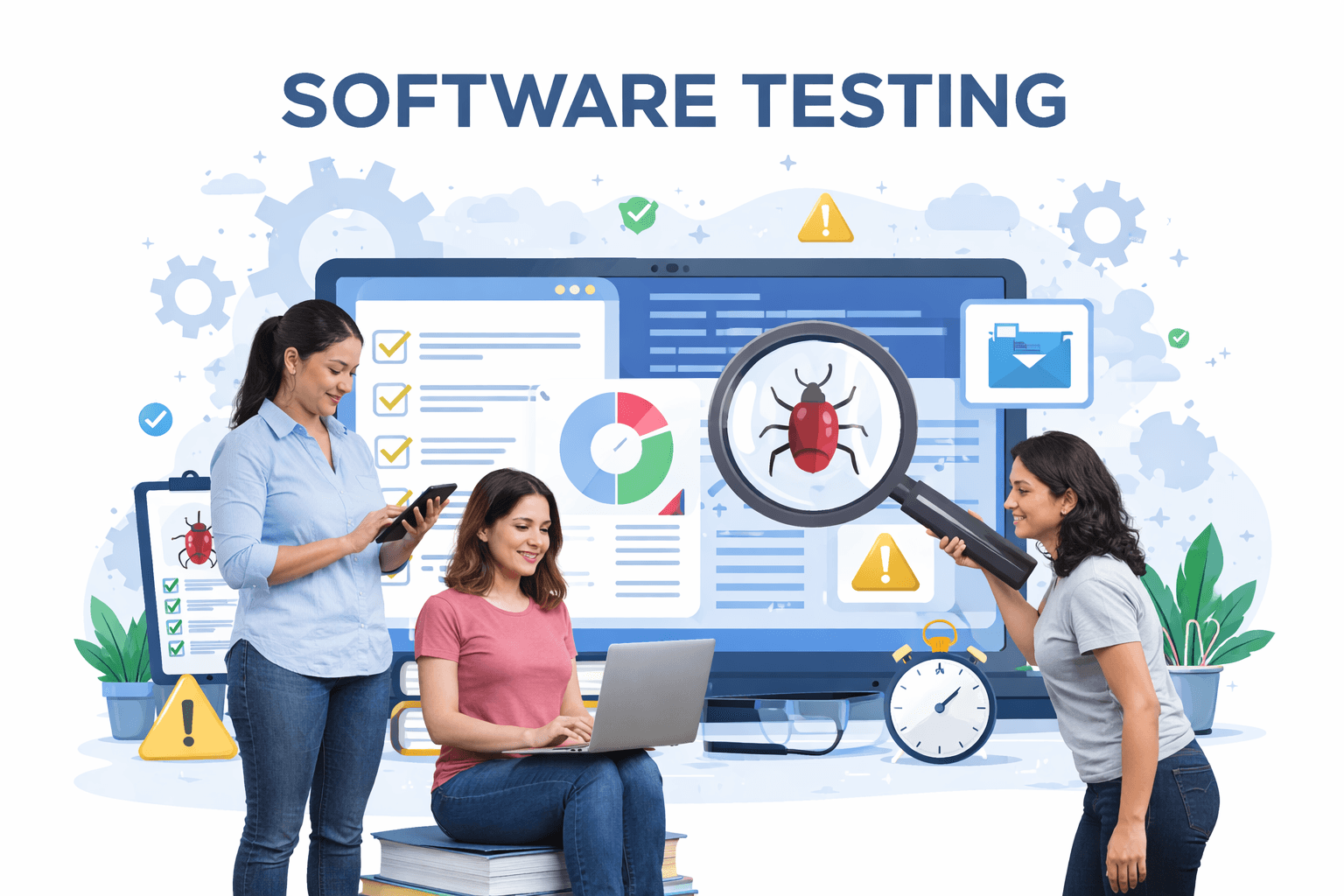
Today's economic system has transformed into a digital world. For bank apps or online shopping, users wish for smooth, safe, and error-free transactions. Software Testing and Quality Assurance (QA) is essential in this regard to ensure secure processing. In 2026, many software engineers are dreaming of a Software Tester career. The Software Testing Course can prove beneficial for them as a thorough guide on QA and Automation Testing.
A Precise Picture of Software Testing
Software Testing is a process to find flaws, ensure utility, and confirm the service satisfaction of the business users.
The main aim for performing software testing are:
Early detection of bugs in the software application
Make sure the functionality and dependability of the product
Verify the user experience of the program
Improves the security policy and compliance
Testing the software program can be done by
Manual Testing
Automation Testing
Functional Testing
Non-Functional Testing
Regression Testing
Performance Testing
Role of Quality Assurance in Software Testing
Quality Assurance is a kind of processing method that assures the quality of the application. It is done throughout the software development lifecycle (SDLC). A Quality Assurance professional has to do many tasks on a daily basis. These
Analysis of requirements
Planning tests
Improving processes
Continuous surveillance
To become a qualified Quality Assurance Engineers need both technical and analytical abilities. These skills you can acquire from the Software Testing Course in Delhi to perform effective software testing.
You need to know technical skills:
Knowledge of SDLC & STLC
Understanding of testing tools
Basic programming (Java/Python)
API testing (Postman, REST Assured)
Database knowledge (SQL)
Also, you have to develop soft skills:
Analytical thinking
Attention to detail
Communication skills
Ultimate Guide on Automation Testing
What is Automation Testing?
Using scripts and special tools to test software is referred to as Automation testing. Without involving human intervention, this testing improves test coverage. Frameworks, scripts, and tools are used in Automation Testing to run test cases automatically. It does a comparison between actual and expected results. Most importantly, this testing produces a detailed report.
Benefits of Automation Software Testing
Automation Testing has important advantages for organizations.
a) Compared to Manual Software Testing, Automation Software Testing is faster in execution.
b) In this testing, fewer manual mistakes are found with more accuracy.
c) It uses the same test scripts several times.
d) Automation testing checks everything more carefully than manual testing.
e) It works well with CI/CD pipelines.
Classification of Automation Testing
1. Functional Automation Testing: Scripts are used to check the process of the application.
2. Regression Automation Testing: This testing will not affect the existing functionality while making new code changes.
3. Performance Testing: Performance Testing uses tools like JMeter. It checks how far a system can work under load.
4. API Automation Testing: This testing requires tools like Postman or REST Assured. It oversees backend services.
5. UI Automation Testing: Testing using UI Automation lets the tester know how a user interacts with the interface. The Selenium tool is used for this testing.
Manual Testing Versus Automation Testing
Aspect | Manual Testing | Automation Testing |
Execution Speed | Slow | Fast |
Accuracy | Moderate | High |
Cost | Low initially | Higher setup cost |
Scalability | Limited | Highly scalable |
Best For | Exploratory testing | Regression testing |
Tools for Automation Testing
1. Selenium - Selenium is one of the most common open-source tools. It is used for automating web tasks. It has some good features like
ü Multi-language support (Java, Python, C#)
ü Compatibility with all kinds of internet browsers
ü Support from a large section of people
Software testers need to take Selenium Training in Delhi to gain technical know-how for using it.
2. Playwright - This is a modern framework. It has great features, including fast execution and higher reliability.
3. Cypress - Cypress is ideal for front-end application testing. It can be used to test the JavaScript-based apps.
4. Appium - Appium tool helps in automating mobile apps.
5. TestComplete - This is a commercial tool. It is used for UI testing.
Automation Testing Design
Frameworks give automation structure and scalability. Automation Testing has common framework types, such as
Data-Driven Framework
Keyword-Driven Framework
Hybrid Framework
Behaviour-Driven Development (BDD)
Automation Testing Life Cycle
This developed testing goes through stages to complete the process of software application testing.
Tool Selection
Test Planning
Framework Design
Script Development
Test Execution
Reporting and Maintenance
To Conclude
The year 2026 witnessed advancements in software testing tools and employment stability paved a new career path. Testers are using technologies like Selenium and modern frameworks. These techniques increased the productivity and reliability of the applications. QA specialists have occupied a strong position in the software environment for automation, AI, and DevOps.