What Are the Different Types of Testing in Software Testing?
Jul 1, 2026

Introduction
Building excellent software requires much more than just writing code. It is crucial to make sure that your application works flawlessly for all users. Even the slightest changes in code can bring bugs into the system. This is why technology specialists need to develop rigorous testing strategies before releasing their applications onto live servers.
If you are studying the Software Testing Online Course at the moment, then you will get acquainted with these basic approaches right away. Knowledge of these testing types will help you choose the appropriate strategy for your project.
What Is Software Testing?
Software testing is the systematic process of checking an application to find bugs, errors, and design gaps. The primary goal is to match the final product with the original business requirements. In modern engineering, testing is never a final step done at the very end. It is a continuous quality check that runs parallel to regular development work.
Functional Testing vs. Non-Functional Testing
We divide software testing into two large, essential main groups. Functional testing checks what the application does by looking at business rules. Non-functional testing checks how well the application runs by looking at speed and safety.
Testing Category | Core Focus | Key Question Asked | Real-World Example |
Functional | App features and rules | Does the button send the form? | Checking if a user can add items to a digital shopping cart. |
Non-Functional | Speed, scale, and safety | How fast does the page load? | Checking if the app crashes when 10,000 users visit at once. |
You must use both testing categories to deliver a software product that is stable, fast, and secure.
Different Types of Functional Testing
Function testing tests your software application modules according to the set technical standards. Four levels of testing are used by engineers to debug issues within the code.
Unit Testing: This is testing of the smallest units of source code that include functions or methods. Coders perform this test during code writing in order to detect any logical mistakes.
Integration Testing: This level tests the interaction between the code modules in data transmission. Students who would like to practice testing through complex API setups can find a Software Testing Course in Delhi.
System Testing: This test is performed by the QA department on a fully integrated application. System test verifies that the whole package works without a hitch for the end-user.
Acceptance Testing: This is the last test before deploying the application. Clients perform this test in order to verify whether the build meets all the business requirements.
Different Types of Non-Functional Testing
After making sure that all key functionalities are working, the operational characteristics, like performance and data security, should be tested.
Performance Testing: Performance tests include load tests that test how responsive the system is under normal usage. They also include stress tests that identify the failure point of the infrastructure.
Security Testing: Technicians find out where there may be any vulnerabilities in the application architecture so that no hackers can steal users’ passwords and gain access to the central database.
Usability Testing: Analysts observe users as they navigate through different interfaces of the user interface layout.
Black Box Testing vs. White Box Testing
Testing methodologies are also classified according to the degree of visibility the tester has of the source code when conducting the test.
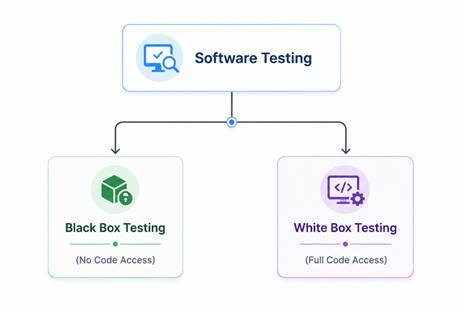
Black Box Testing: The tester is in contact only with the user-visible screen interface. The tester does not have access to the code that goes on behind the scenes.
White Box Testing: The tester examines the code structure and logic. You need to be a good programmer to conduct this type of test.
When Is Each Testing Type Used?
Quality assurance teams run specific tests at designated intervals during the project lifecycle to save time.
Testing Type | When to Use | Main Goal |
Unit Testing | Active Development Phase | Fixes small math or logic bugs immediately after code creation. |
Integration Testing | Module Assembly Phase | Checks the data links between different combined features. |
System Testing | Complete Build Assembly | Tests the entire software package as a single operational unit. |
Acceptance Testing | Pre-Release Phase | Gets final project approval from the client before launching live. |
Performance Testing | Final Staging Phase | Make sure the web servers handle high network traffic spikes. |
How Different Testing Types Work Together in Software Projects?
In a tech company, however, the above-mentioned tests operate as a team that works in cohesion like a sports team. Together, they form a safety net that helps ensure that no defective features get into the hands of users.
The practical workflow moves through these five sequential steps:
Write and Check: The developer develops a feature and performs Unit Tests to validate its core algorithm.
Combine Components: The development team connects new components and performs Integration Tests to validate the database connection.
Test the Whole App: The development team deploys the entire application onto a test server and performs System Testing.
Check the Speed: The specialised team performs Performance and Security Tests to ensure that the app is safe and fast.
Final Sign-Off: The client performs Acceptance Tests to validate the final decision to deploy the app.
Why Learning Different Testing Types Is Important?
Each software requires various layers of protection to keep its integrity. Knowing how to use each particular type of testing greatly enhances the reliability of the project. The problem is that if the engineer uses only one way, then it would be quite easy to let some critical bugs go unnoticed and make their way into the working application.
As an example, if a website works fast but the registration form does not allow entering the data properly, it is absolutely useless. People who want to learn about these different types of validation usually go for Software Testing Classes in Bangalore.
Knowing the limitations of each testing method allows for finding errors more quickly when developing a project. It will be possible to create better automated testing sets and get test coverage profiles.
Conclusion
Each bug that you catch during testing means one big problem fixed for future users. Knowing how to do testing using functional, non-functional, black box, and white box testing will make all digital systems around the world secure. Enjoy the process of writing great code and learn from free software projects.